
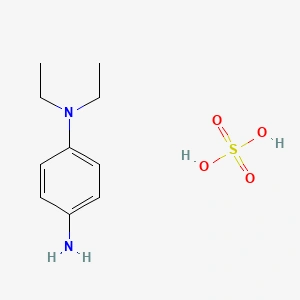
N,N-Diethyl-p-phenylenediamine sulfate
N,N-Diethyl-p-phenylenediamine sulfate, identified by CAS 6283-63-2, is a specialized organic salt that serves as a critical reagent in analytical chemistry and industrial synthesis. Appearing as a white to slightly off-white crystalline powder, this compound is the sulfate derivative of N,N-diethyl-p-phenylenediamine. It is highly valued for its role as a redox indicator, characterized by its ability to undergo distinct colorimetric changes upon oxidation. The material is sensitive to light, moisture, and atmospheric oxygen, necessitating controlled storage conditions to maintain its chemical integrity. In professional laboratory and industrial contexts, it is recognized for its high sensitivity and reliability in detecting oxidizing species. As a chemical raw material, it provides the necessary reactivity for color-forming processes, making it a staple in environmental monitoring, photographic development, and various research-driven diagnostic applications where precise oxidative detection is required.
• Water Quality and Environmental Monitoring: The primary application of CAS 6283-63-2 is in the colorimetric determination of free and total residual chlorine in aqueous solutions. When introduced to water samples containing oxidants like chlorine, ozone, or bromine, the reagent produces a characteristic pink-to-red color. This reaction is fundamental for municipal water treatment, swimming pool maintenance, and industrial wastewater analysis to ensure disinfectant levels are within safe parameters.
• Photographic Chemical Processing: In the traditional photography industry, this compound functions as a key color developing agent. It facilitates the reduction of silver halide grains and subsequently reacts with color couplers to generate dyes within the film or paper emulsion. Its chemical structure is essential for achieving accurate color reproduction and stable image formation in chromogenic processes.
• Biochemical and Analytical Research: The compound is frequently utilized as a redox indicator in various laboratory assays. Researchers employ it to monitor enzymatic reactions and electron transfer processes due to its reversible oxidation-reduction properties. It is also used in the development of specialized chemical sensors designed to detect trace amounts of peroxides and other reactive oxygen species.
• Industrial Synthesis Intermediate: It serves as a precursor in the manufacture of various organic dyes and specialized chemical stabilizers. The N,N-diethyl substitution on the phenylenediamine backbone allows for specific chemical modifications, making it a versatile building block for producing complex molecules used in textile coloring and material science.
Product Name: N,N-Diethyl-p-phenylenediamine sulfate
For global customers, we provide complete technical documentation to support product evaluation, regulatory compliance and safe handling during transportation and application.