
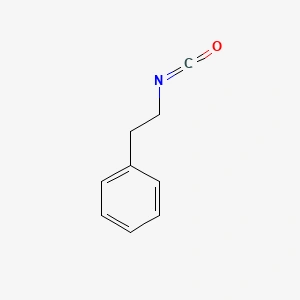
Phenethyl isocyanate
Phenethyl isocyanate, identified by CAS number 1943-82-4, is a versatile organic building block characterized by its reactive isocyanate functional group attached to a phenethyl moiety. This clear to pale yellow liquid serves as a crucial intermediate in the synthesis of various carbamates, ureas, and heterocyclic compounds. Its chemical structure, featuring an ethyl bridge between the phenyl ring and the isocyanate group, provides unique steric and electronic properties that are highly valued in fine chemical synthesis and molecular design.
In industrial and research settings, this compound is primarily utilized for its ability to undergo addition reactions with nucleophiles such as alcohols and amines. Due to its reactivity, handling requires strict adherence to anhydrous conditions, typically under an inert gas atmosphere like nitrogen or argon, to prevent hydrolysis. Its role as a precursor makes it indispensable for developing specialized polymers, agricultural chemicals, and pharmaceutical derivatives where a phenethyl substituent is required to modify biological activity or physical properties.
• In pharmaceutical research, Phenethyl isocyanate is widely employed as a derivatizing agent and intermediate for the synthesis of biologically active molecules. It is particularly useful in the construction of urea-based enzyme inhibitors and carbamate-linked prodrugs, where the phenethyl group can enhance lipophilicity and target binding affinity.
• The compound serves as a critical reagent in organic synthesis for the preparation of various heterocyclic systems. By reacting with bifunctional nucleophiles, it facilitates the formation of oxazolidinones, hydantoins, and other nitrogen-containing rings that are foundational to medicinal chemistry and the development of novel therapeutic agents.
• Within materials science, it is utilized to functionalize polymers and surfaces. The isocyanate group allows for the covalent attachment of the phenethyl moiety to hydroxyl or amine-terminated substrates, modifying surface energy, improving compatibility in polymer blends, or introducing specific aromatic interactions into specialty coatings and adhesives.
• It is also applied in the synthesis of agrochemicals, acting as a precursor for herbicides and fungicides. The introduction of the phenethyl isocyanate fragment into molecular structures helps in fine-tuning the efficacy and environmental stability of these compounds, ensuring targeted action in crop protection applications.
Product Name: Phenethyl isocyanate
For global customers, we provide complete technical documentation to support product evaluation, regulatory compliance and safe handling during transportation and application.