
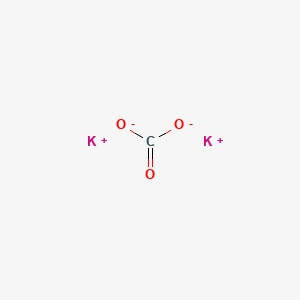
Potassium carbonate, identified by CAS 584-08-7, is a prominent inorganic compound that appears as a white, deliquescent salt. As a primary alkali, it is highly soluble in water, forming a strongly alkaline solution, though it remains insoluble in ethanol. Historically derived from wood ashes and known as potash, modern industrial production typically involves the reaction of potassium hydroxide with carbon dioxide. Its chemical stability and basicity make it a fundamental reagent in various synthetic processes and industrial applications.
In industrial and research settings, potassium carbonate is valued for its role as a buffering agent and a source of potassium ions. Due to its hygroscopic nature, it must be stored in tightly sealed containers to prevent clumping and degradation from atmospheric moisture. Its versatility extends from heavy industrial manufacturing to specialized laboratory synthesis, where it serves as a mild base for organic reactions, facilitating deprotonation without the extreme reactivity associated with stronger hydroxides.