
English | 中文 | Español

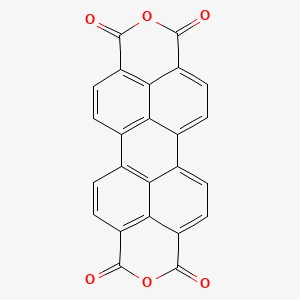
PTCDA

CAS No.:128-69-8
Product Grade: Industrial Grade
Purity / Assay: 98%
Molecular Formula:C₂₄H₈O₆
Molecular Weight:392.32
Synonym(s):Perylene-3,4,9,10-tetracarboxylic Dianhydride; 3,4,9,10-Perylenetetracarboxylic Dianhydride; Pigment Red 224; Perylenetetracarboxylic Dianhydride

PTCDA (CAS: 128-69-8), perylene-3,4,9,10-tetracarboxylic dianhydride, is a planar aromatic dianhydride that serves as the parent for perylene pigments and organic electronic materials.

It forms highly ordered thin films, strong light absorption and good electron-transport behaviour, and it is very stable to heat and light.

It is therefore used for perylene diimide dyes and in organic semiconductor, solar-cell and OLED research.

It is a very stable, high-melting powder that should be stored dry and away from strong alkalis. Typical specifications include assay, colour and residual monoanhydride, which influence pigment shade and film quality.

• Perylene pigment and dye synthesis: condensed with amines to give perylene diimides with excellent lightfastness. The diimide products are known for exceptional lightfastness.

• Organic electronics: electron-transport and acceptor material for thin-film transistors and photovoltaic devices. High-purity, sublimed grades are preferred for device-grade films.

• Fluorescent materials: building block for fluorescent probes and high-performance colorants. It is widely studied as a model organic semiconductor.

• Automotive and industrial coatings: its pigment derivatives provide durable red and maroon shades for demanding weather-resistant finishes.

1kg/bag, 25kg/drum
CAS No.: 128-69-8

Product Name: PTCDA

Purity / Assay:98%
Molecular Formula:C₂₄H₈O₆
Molecular Weight:392.32
Synonym(s):Perylene-3,4,9,10-tetracarboxylic Dianhydride; 3,4,9,10-Perylenetetracarboxylic Dianhydride; Pigment Red 224; Perylenetetracarboxylic Dianhydride

PTCDA (CAS: 128-69-8), perylene-3,4,9,10-tetracarboxylic dianhydride, is a planar aromatic dianhydride that serves as the parent for perylene pigments and organic electronic materials.

It forms highly ordered thin films, strong light absorption and good electron-transport behaviour, and it is very stable to heat and light.

It is therefore used for perylene diimide dyes and in organic semiconductor, solar-cell and OLED research.

It is a very stable, high-melting powder that should be stored dry and away from strong alkalis. Typical specifications include assay, colour and residual monoanhydride, which influence pigment shade and film quality.

For global customers, we provide complete technical documentation to support product evaluation, regulatory compliance and safe handling during transportation and application.

REQUEST A QUOTE

Product Inquiry — Popup Form