
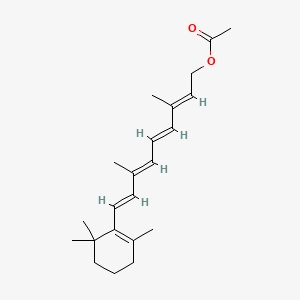
Retinyl acetate, identified by CAS number 127-47-9, is a natural form of Vitamin A and the acetate ester of retinol. It typically appears as a pale yellow crystalline solid or a viscous liquid, depending on the temperature and purity. As a fat-soluble retinoid, it exhibits significant stability compared to pure retinol, making it a preferred precursor in various industrial formulations. It is chemically characterized by its unsaturated hydrocarbon chain and ester linkage, which requires careful storage away from light and oxygen to prevent degradation.
In industrial and research settings, retinyl acetate serves as a critical synthetic intermediate and a stable source of Vitamin A activity. Its handling requires specific protocols, often involving inert atmospheres and amber glass containers to maintain potency. Because it is easily converted to other retinoids within biological systems, it is highly valued for its predictable behavior in laboratory assays and formulation science, bridging the gap between raw chemical synthesis and functional applications.