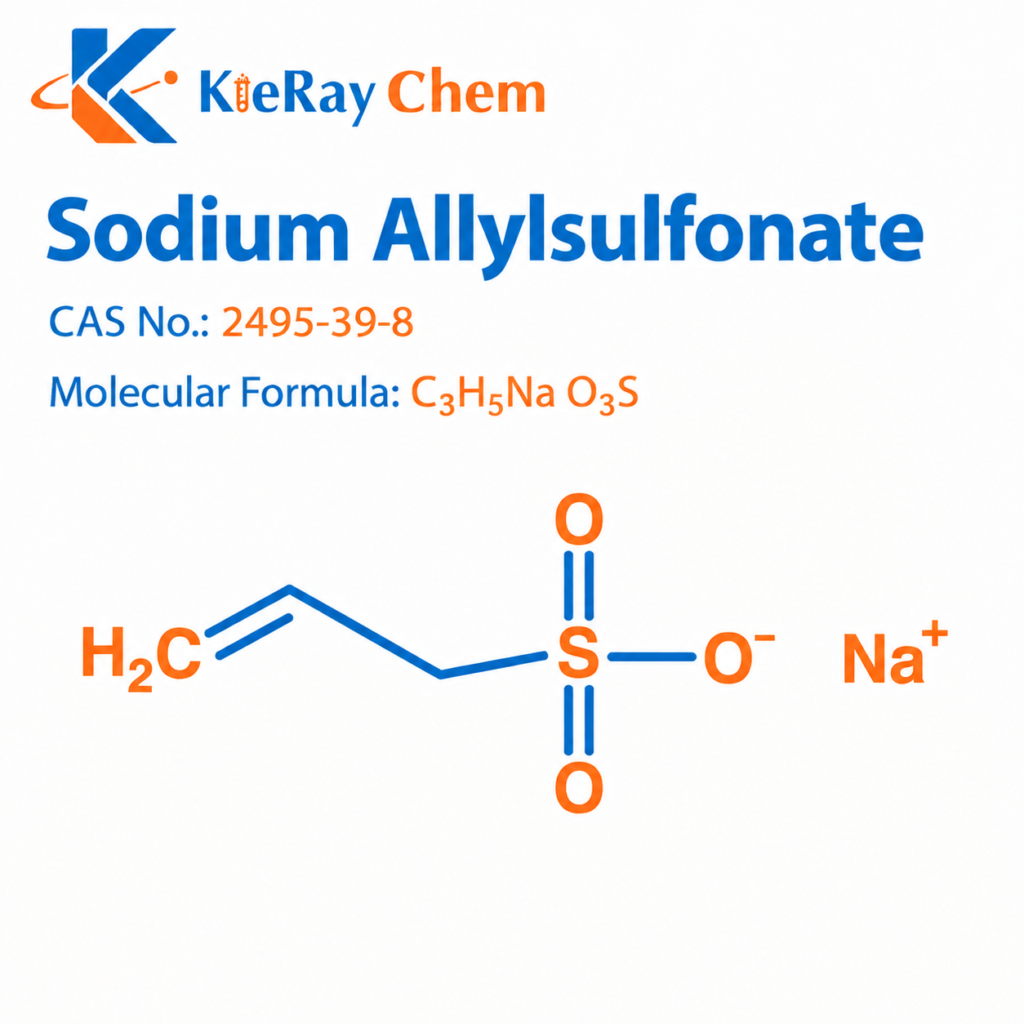
Sodium Allylsulfonate (CAS: 2495-39-8) (SAS), is a highly reactive, water-soluble functional monomer widely utilized across various industrial sectors. Its core applications include:
- Textile Manufacturing: It serves as a crucial third monomer in acrylic fiber production. Copolymerizing it with acrylonitrile significantly improves the fibers’ heat resistance, elasticity, spinnability, and dyeability, enabling rapid dye uptake and superior colorfastness.
- Electroplating Industry: It is widely used as a basic or auxiliary brightener in nickel electroplating baths. It enhances the uniformity, throwing power, and ductility of the metal coating, ensuring a smooth, reflective, and high-quality finish.
- Polymer & Water Treatment: Due to its reactive allyl and hydrophilic sulfonate groups, it acts as a performance co-monomer or reactive emulsifier. It helps synthesize functional polymers used as industrial water stabilizers, flocculants, and oilfield drilling mud additives.
- Construction & Civil Engineering: It is employed in formulating commercial concrete as a water reducer (superplasticizer) and early-strength agent to enhance mechanical performance.
- Chemical Synthesis: It serves as an essential pharmaceutical intermediate for developing various active therapeutic compounds.
KIERAY CHEM operates as a premier, China-based supplier of high-purity Sodium Allylsulfonate (SAS), leveraging advanced manufacturing and a robust supply chain to ensure consistent, batch-to-batch industrial quality. The enterprise delivers compliant global logistics and technical support, establishing itself as a trusted strategic partner for international clients across the acrylic fiber, electroplating, water treatment, and construction sectors.
Comprehensive Industrial Applications
Class I: Construction & Cement Chemistries
1. Polycarboxylate Ether (PCE) Superplasticizers
- Technical Statement: Utilized as a functional monomer in Polycarboxylate High-Performance Water Reducers. When copolymerized or formulated with maleic anhydride, poly(ethylene glycol) methyl ether (MPEG), and methacrylic acid (MAA), it delivers low dosage requirements, high water-reduction efficiency, exceptional slump retention (retardation), and excellent bleeding resistance.
- Chemical Mechanism: The incorporation of the strong anionic sulfonate group (-SO₃Na) intensifies electrostatic repulsion and steric hindrance profiles on the surface of cement particles. It maintains concrete workability over extended transportation intervals without sacrificing setting times or inducing cement segregation.
2. Cement Workability Retainers
- Technical Statement: Formulated into advanced concrete admixtures as a specialized slump-retention and workability-retaining agent to optimize consistency and long-term rheology.
- Chemical Mechanism: It controls the competitive adsorption kinetics of the polymer onto hydrating cement minerals, ensuring uniform dispersion over a prolonged timeframe.
Class II: Petroleum, Oilfield & Water Treatment Chemistries
3. Water Treatment Scale & Corrosion Inhibitors
- Technical Statement: Acts as a specialized reactive monomer for scale and corrosion inhibitors in industrial water treatment. It undergoes multi-component copolymerization with acrylic acid (AA), acrylamide (AM), maleic anhydride (MA), sodium hypophosphite, and vinyl acetate (VAc) to exhibit outstanding scale inhibition profiles against calcium phosphate, zinc salts, calcium carbonate, and calcium sulfate.
- Chemical Mechanism: The repeating sulfonate segments offer robust structural chelating binding sites for multi-valent hardness ions (Ca²⁺, Zn²⁺). This disrupts the structural lattice growth of microcrystalline scales and ensures high-performance dispersion in high-salinity, high-temperature cooling loops.
4. Drilling Fluids & High-Temperature Fluid-Loss Additives
- Technical Statement: Applied in petrochemical formulations, where it is copolymerized with acrylamide (AM), acrylic acid (AA), acrylamidopropyltrimethylammonium chloride (APTMAC), acrylamidoethyldimethylammonium chloride, diallyldimethylammonium chloride (DADMAC), or allyltrimethylammonium chloride (ATMAC). This delivers highly effective dispersants and fluid-loss additives characterized by exceptional thermal stability and salt-tolerance.
- Chemical Mechanism: The Carbon-Sulfur (C-S) covalent bond embedded in the SAS structure displays superior thermal and hydrolytic resistance. Copolymerizing it with cationic and non-ionic segments yields zwitterionic polymers that form tough, dense mud cakes, sustaining structural rheological performance across ultra-deep, high-temperature, and saturated-brine wellbore environments.
5. Enhanced Oil Recovery (EOR) Flooting Agents
- Technical Statement: Implemented as a key polymer constituent in Enhanced Oil Recovery (EOR) surfactants and chemical flooding formulations to improve mobility control.
- Chemical Mechanism: It improves the shear-thinning resistance and chemical stability of flooding polymers within highly mineralized oil reservoirs, broadening the volumetric sweep efficiency of the aqueous phase.
Class III: Fiber, Coatings & Flocculant Technologies
6. Acrylic Fiber Modifications
- Technical Statement: Employed as the third monomer for polyacrylonitrile (PAN) fibers (acrylic fibers) to drastically optimize dyeability. It accelerates dye uptake, enhances color fastness, ensures vibrant shades, and simultaneously upgrades the thermal stability and elasticity of the fibers.
- Chemical Mechanism: SAS anchors uniform anionic dyeing sites along the PAN backbone. This configuration maximizes binding kinetics with cationic/basic dyes, while its side chains disrupt rigid polymer crystallization, yielding improvements in fiber elasticity and structural heat resistance.
7. Coating Additives & Specialty Resins
- Technical Statement: Serving as a processing additive in industrial coatings to synthesize thermosetting acrylic resins and advanced coating dispersants, significantly enhancing water solubility and mechanical stability.
- Chemical Mechanism: During emulsion polymerization, it covalently embeds as a hydrophilic segment, acting as a built-in surfactant that prevents emulsion coalescing and boosts mechanical shear resistance.
8. Industrial Flocculants
- Technical Statement: Acts as a reactive functional monomer for industrial flocculant synthesis through copolymerization with acrylamide (AM).
- Chemical Mechanism: It generates high-molecular-weight anionic polyacrylamides (APAM), which bring about rapid particulate aggregation via charge neutralization and inter-particle polymer bridging during wastewater treatment and sludge dewatering.
9. Polymeric Dispersants
- Technical Statement: Copolymerized with methacrylic acid (MAA) and itaconic acid (IA) to produce premium-grade polymeric dispersants and chelating agents.
- Chemical Mechanism: The dense alignment of combined carboxylic and sulfonic acid functionalities provides superb sterical stabilization for dispersing ultra-fine inorganic pigments such as TiO₂ and calcium carbonate slurries.
Class IV: Advanced Functional Materials
10. Single-Ion Comb-like Polymer Electrolyte Membranes (CPPL)
- Technical Statement: Deployed in electronic applications and precision material processing to fabricate Single-Ion Comb-like Polymer Electrolyte Membranes (CPPL) and Superabsorbent Polymers (SAP).
- Chemical Mechanism: In high-energy lithium batteries, the comb-like topological structure anchors sulfonate anions to the polymer matrix. This restricts anion movement while enabling high lithium-ion transference numbers, suppressing lithium dendrite formation.
Class V: Agronomical & Paper Engineering
11. Soil Conditioners & Nutrient Retainers
- Technical Statement: Applied in agricultural soil conditioning. Copolymerized with sodium acrylate, styrene-acrylic emulsions, and poly(vinyl alcohol) (PVA) to enhance the nutrient retention capacity of lateritic red soils, validating an exceptionally strong adsorption affinity toward ammonium (NH₄⁺) and nitrate (NO₃⁻) ions.
- Chemical Mechanism: The crosslinked hydrogel network installs highly localized electrostatic fields into porous lateritic soils, trapping essential ions (NH₄⁺ and NO₃⁻) against rainwater leaching while maintaining root bioavailability.
12. Papermaking Dry-Strength Agents
- Technical Statement: Formulated into papermaking wet-end chemical additives as a crucial component of dry-strength agents to substantially upgrade the structural and tensile strength of paper products.
- Chemical Mechanism: It establishes multi-point hydrogen bonding and crosslinking networks with cellulose hydroxyl fractions, reinforcing the tensile index and burst strength of the finished paper.