
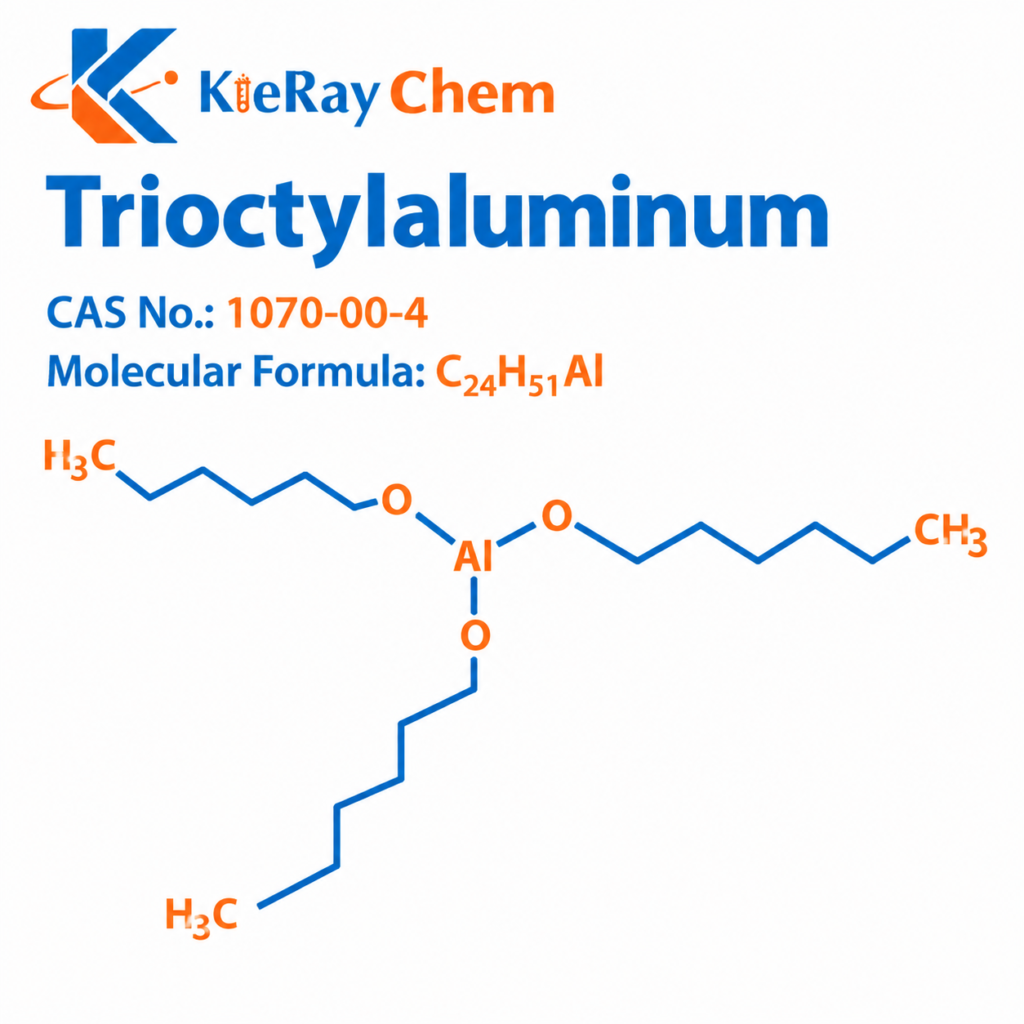
Trioctylaluminum
Trioctylaluminum (CAS:1070-00-4) is an organoaluminum compound used as a high-performance cocatalyst in Ziegler-Natta olefin polymerization and as a reagent in organic synthesis. The colorless, air- and moisture-sensitive solution delivers the precise aluminum-alkyl activity needed for catalyst activation, chain-transfer control and the manufacture of specialty polymers and fine chemicals. As a Industrial Grade product, this material is manufactured with defined process control and released against documented specifications covering assay, impurities and physical properties, which simplifies incoming inspection for buyers. Flexible packaging options including 25kg/drum, 200kg/drum and dependable export logistics make volume sourcing straightforward, while consistent quality protects downstream process reproducibility and end-product performance.
KieRay Chem has established itself as a stable and trustworthy supplier of Trioctylaluminum (CAS:1070-00-4), combining years of manufacturing experience with rigorous quality management. Every batch is tested against tight specifications for assay, impurities and physical properties, and complete COA, technical data sheets and safety documentation are provided with each shipment. Our flexible packaging options, dependable global logistics and responsive technical support ensure that research laboratories, formulators and industrial manufacturers receive consistent material on schedule. Competitive pricing, long-term stock availability and the ability to tailor grades and pack sizes make KieRay Chem the partner of choice for sustaining uninterrupted production and product quality.
## Trioctylaluminum (Tri-n-octylaluminum, TNOA/TOA, CAS 1070-00-4): Key Functions and Uses
1. **Polyolefin Polymerization Cocatalyst**
Trioctylaluminum, also called **tri-n-octylaluminum, TNOA, or TOA**, is an organoaluminum compound primarily used as a cocatalyst in **Ziegler–Natta polymerization**. It helps activate transition-metal catalyst systems used to produce polyolefins.
2. **Olefin and Diene Polymerization**
CAS 1070-00-4 is used in the polymerization of olefins and selected dienes. It can support the production and development of polyethylene, polypropylene, elastomers, and other specialty polymers, depending on the catalyst system and process conditions.
3. **Catalyst Activation and Alkyl Transfer**
Trioctylaluminum can alkylate or activate transition-metal catalyst components, helping generate catalytically active species. Its long-chain octyl groups may also influence catalyst behavior, polymerization kinetics, molecular-weight distribution, and process performance.
4. **Polymer Manufacturing and Process Development**
This material is relevant to industrial polymer production, catalyst screening, pilot-scale process development, and research into high-performance plastics and synthetic elastomers. Actual polymer properties depend on catalyst composition, monomer selection, solvent, temperature, and process design.
5. **Alkylating Reagent in Organometallic Chemistry**
Trioctylaluminum can serve as an alkylating reagent and aluminum-containing building block in the preparation of other organometallic compounds. It is useful for studying alkyl-transfer reactions, metal–carbon chemistry, and specialized synthetic routes.
6. **Organic Synthesis and Specialty Chemical Research**
In selected laboratory applications, TOA may act as a reactive organoaluminum reagent in organic synthesis. Its use can support the preparation of functional intermediates and the investigation of Lewis-acidic or alkylation-related reaction pathways.
7. **Quality and Procurement Considerations**
When sourcing Trioctylaluminum 1070-00-4, buyers should verify active concentration, solvent system, purity, aluminum content, packaging, batch consistency, certificate of analysis, and compatibility with the intended catalyst process. Useful SEO keywords include **Trioctylaluminum, tri-n-octylaluminum, TNOA, TOA, CAS 1070-00-4, Ziegler–Natta cocatalyst, polyolefin catalyst, organoaluminum reagent, and polymerization activator**.
8. **Strict Professional Handling Requirement**
Trioctylaluminum is highly reactive, flammable, and potentially pyrophoric. It can react violently with water, air, and incompatible materials, and may cause severe chemical burns. Handling requires trained personnel, suitable inert-atmosphere equipment, approved storage and transport procedures, and strict compliance with the supplier’s **Safety Data Sheet and applicable regulations**.
Product Name: Trioctylaluminum
For global customers, we provide complete technical documentation to support product evaluation, regulatory compliance and safe handling during transportation and application.