
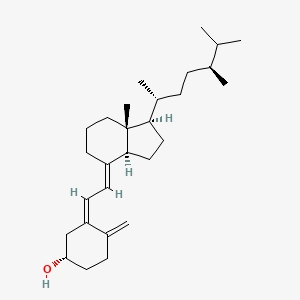
Vitamin D4, chemically identified as 22,23-dihydroergocalciferol, is a fat-soluble secosteroid that represents a less common but structurally significant member of the vitamin D family. It is typically produced through the irradiation of 22,23-dihydroergosterol and is found naturally in various fungal species and certain plant materials. Structurally, it differs from ergocalciferol (D2) by the saturation of the double bond at the C22-C23 position in its side chain. In its pure form, this compound appears as a crystalline solid that is sensitive to environmental factors such as light, oxygen, and high temperatures, requiring controlled handling and storage to ensure stability.
From an industrial and scientific perspective, Vitamin D4 is valued for its specific chemical profile and its role in comparative sterol studies. It serves as a vital tool for researchers investigating the nuances of secosteroid biochemistry and the structural requirements for biological activity. As a specialized raw material, it provides a distinct pathway for the synthesis of derivatives and facilitates the exploration of metabolic pathways that differ from the more common D2 and D3 analogs, making it a niche yet essential component in advanced chemical research.