English | 中文 | Español

Chemical Products

image failed

Karstedt’s Catalyst

Karstedt’s catalyst is a platinum(0) complex of 1,3-divinyl-1,1,3,3-tetramethyldisiloxane, normally supplied as a solution containing about 2% platinum. The platinum centre is stabilised by two vinylsiloxane ligands, giving a highly active homogeneous hydrosilylation catalyst compatible with silicone systems.

Karstedt’s Catalyst Read More »
Murexide

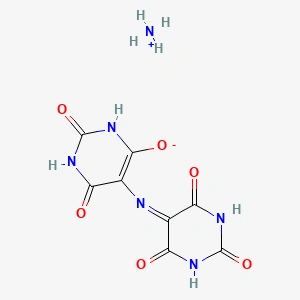
Murexide, the ammonium salt of purpuric acid, is a purple-red to reddish-brown powder supplied at 95% purity as a classical analytical reagent. Its colour depends on the metal ions present and on pH: the free indicator is violet, turns yellow-green in acidic media and gives stable, strongly coloured complexes with calcium, copper, nickel and other

Murexide Read More »

Butylferrocene

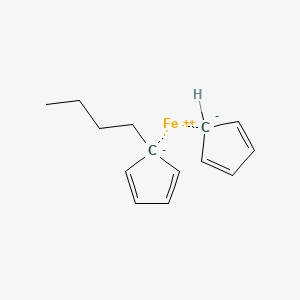
Butylferrocene is an iron sandwich compound in which one cyclopentadienyl ring carries an n-butyl substituent, supplied as an orange to brown clear liquid at 98% purity. The ferrocene core provides a reversible one-electron redox couple, thermal stability and a lipophilic, low-toxicity organometallic skeleton, while the butyl chain improves solubility in hydrocarbons and polymers. These properties

Butylferrocene Read More »

Nalidixic Acid

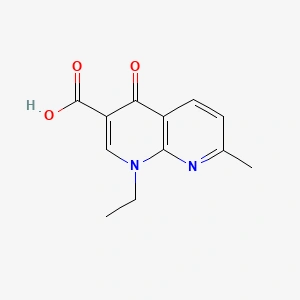
Nalidixic Acid (CAS: 389-08-2) is a synthetic quinolone-class antibacterial compound and the first of the quinolone family. It acts by inhibiting bacterial DNA gyrase. It appears as a white to pale yellow crystalline powder, sparingly soluble in water and soluble in alkaline solutions and some organic solvents. Today it is used mainly as a pharmaceutical

Nalidixic Acid Read More »

Lasalocid Sodium

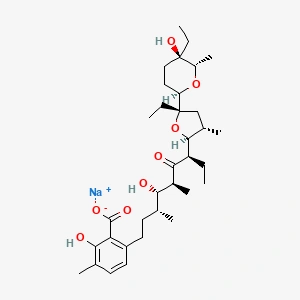
Lasalocid sodium is the sodium salt of a polyether carboxylic acid ionophore produced by fermentation, supplied as an off-white to pale yellow powder at 90% assay. The molecule wraps around monovalent and divalent cations and shuttles them across lipid membranes, which disturbs the ion balance of sensitive microorganisms and improves nutrient utilisation in the animal

Lasalocid Sodium Read More »

Polyamine N7

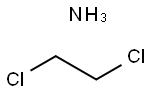
Polyamine N7 is a water-soluble cationic polyamine obtained by copolymerisation of ammonia with 1,2-dichloroethane, normally supplied as a 50% aqueous solution. The polymer has a distribution of chain lengths; the repeat unit is commonly represented as (C₂H₄Cl₂·H₃N)x. Protonated amine groups adsorb strongly onto negatively charged surfaces.

Polyamine N7 Read More »

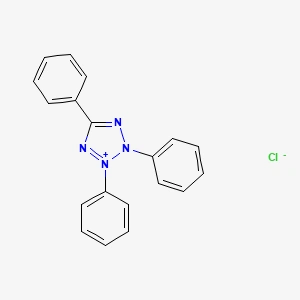
Triphenyltetrazolium Chloride

Triphenyltetrazolium chloride is a water-soluble tetrazolium salt, supplied as a white to pale yellow crystalline powder at 98% purity. In living tissues the colourless salt is reduced by dehydrogenase activity to formazan, an intensely red, water-insoluble pigment, so the intensity of the colour reports directly on metabolic activity and cell viability. This simple, robust chemistry

Triphenyltetrazolium Chloride Read More »

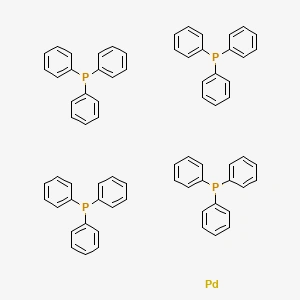
Tetrakis(triphenylphosphine)palladium(0)

Tetrakis(triphenylphosphine)palladium(0) (CAS: 14221-01-3) is a ready-to-use zero-valent palladium complex and one of the most widely applied catalysts for carbon-carbon and carbon-heteroatom bond formation. As a pre-formed palladium(0) source it initiates reactions without an activation step, giving dependable performance in Suzuki, Stille, Sonogashira, Heck and Negishi couplings. The yellow crystalline solid is sensitive to air, light

Tetrakis(triphenylphosphine)palladium(0) Read More »

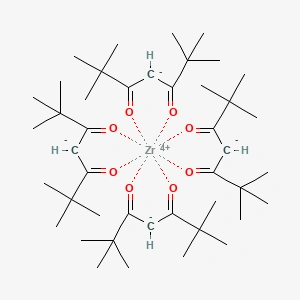
Zr(TMHD)4

Zr(TMHD)4 is the tetrakis(2,2,6,6-tetramethyl-3,5-heptanedionato) complex of zirconium, a white to off-white crystalline powder of 99% purity. The four bulky β-diketonate ligands shield the metal centre and make the complex volatile and thermally stable enough to be transported in the gas phase, while remaining cleanly decomposable to zirconium oxide. This balance of volatility and stability is

Zr(TMHD)4 Read More »

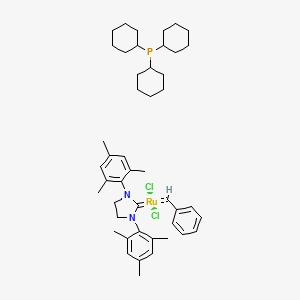
Grubbs Catalyst 2nd Generation

Grubbs Catalyst 2nd Generation (CAS: 246047-72-3) is a ruthenium carbene complex bearing an N-heterocyclic carbene ligand, developed for olefin metathesis. Compared with first-generation systems it offers higher activity, better tolerance of functional groups and improved thermal stability, and it is handled in air as a solid with reasonable convenience. It is used for ring-closing, cross

Grubbs Catalyst 2nd Generation Read More »

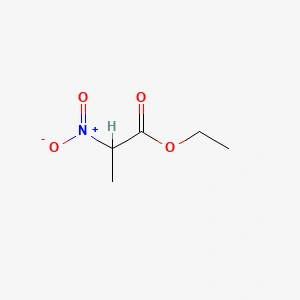
Ethyl 2-Nitropropionate

Ethyl 2-nitropropionate is the ethyl ester of 2-nitropropionic acid, supplied as a colourless to pale yellow clear liquid at 98% purity. The molecule combines an acidic α-hydrogen with a strong electron-withdrawing nitro group, giving it high reactivity in Michael additions, alkylations and condensations, where the nitro group can later be reduced, displaced or converted into

Ethyl 2-Nitropropionate Read More »

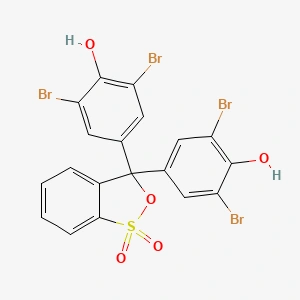
Bromophenol Blue

Bromophenol Blue (CAS: 115-39-9) is a sulfonphthalein dye widely used as a pH indicator and tracking dye in laboratories. It changes from yellow at about pH 3.0 to blue-violet at about pH 4.6. Because it is stable, strongly coloured and easy to dissolve in dilute alkali or ethanol, it is a routine choice for titration,

Bromophenol Blue Read More »

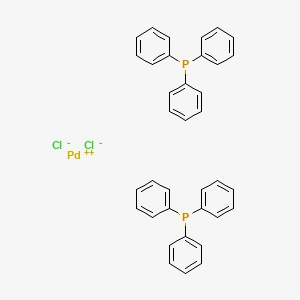
Bis(triphenylphosphine)palladium(II) Dichloride

Bis(triphenylphosphine)palladium(II) Dichloride (CAS: 13965-03-2) is an air-stable palladium(II) phosphine complex used as a homogeneous catalyst precursor in modern cross-coupling chemistry. It is easy to handle compared with many palladium(0) sources and is reduced in situ to the active catalytic species, which makes it a practical choice for both laboratory and production-scale work. The complex is

Bis(triphenylphosphine)palladium(II) Dichloride Read More »

Iridium(IV) Iodide

Iridium(IV) iodide is an inorganic iridium salt with the formula IrI4, supplied as a black crystalline powder at 99% purity. It is a refractory, air- and moisture-sensitive halide that decomposes on heating rather than melting cleanly, and it is handled as a precursor rather than a finished functional material. In the laboratory it serves as

Iridium(IV) Iodide Read More »

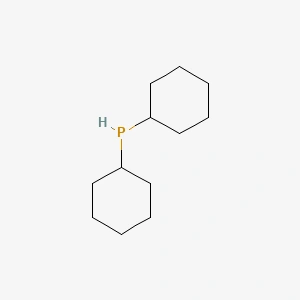
Dicyclohexylphosphine

Dicyclohexylphosphine is a secondary organophosphine carrying two cyclohexyl substituents and one P-H bond, supplied as a colourless to pale yellow clear liquid at 98% purity. The bulky, electron-rich cyclohexyl groups make it a strong σ-donor ligand, and the reactive P-H bond allows it to be converted into phosphine oxides, sulfides, phosphonium salts and metal-phosphido complexes.

Dicyclohexylphosphine Read More »

Diphenylphosphine

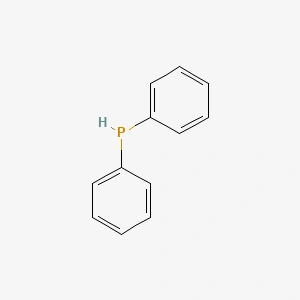
Diphenylphosphine is a secondary aromatic phosphine with two phenyl groups and one P-H bond, supplied as a colourless to pale yellow clear liquid at 98% purity. It is a versatile organophosphorus building block: the labile hydrogen can be replaced by metals, alkyl groups or a second phosphorus centre, while the two phenyl rings provide σ-donor/π-acceptor

Diphenylphosphine Read More »

REQUEST A QUOTE

Product Inquiry — Popup Form